The Frost Date Planting Plan
Plant on the frost odds: your weather station's 90, 50 and 10 percent dates, each crop held to the date its frost class can take, seedling weeks counted from the day it goes out, and a last sowing date for every crop
GardenStuffs' Planting Calendar takes one last spring frost and one first fall frost and counts every crop from them. But a frost date is a probability: on the average date the chance of a later frost is still 50 percent. The calendar does not know which crops can take a frost, and its succession sowings run on without a last date. The plan carries the calendar through. It swaps the one date for your weather station's 90, 50 and 10 percent dates from NOAA's Climate Normals, holds each tender crop to the 10 percent date, counts seedling weeks back from the day each crop goes out, counts days to maturity from transplanting or from sowing, and works out each crop's last sowing date (Virginia Cooperative Extension's count-back). Worked example, Boulder, Colorado: the calendar's five bean sowings include two that fall after June 30, the last sowing date that still leaves two weeks of picking before the tender deadline; tomatoes sown direct leave one week of picking, and peppers sown direct start ripening 12 days after their deadline. Every date is computed from the calculator's own crop table; Boulder's dates are real NOAA figures and the garden is an example. Every outside fact is quoted from its source (Climate.gov, Purdue, Virginia Tech, Maryland, Oregon State and Georgia extension). Included: 24 printable pages with 7 steps, a frost odds sheet, crop plan sheet, last sowing sheet and season frost log, a reference table for twelve crops, a quickstart, and a personalised sheet worked from the dates and crop you enter in the calculator.
Look inside
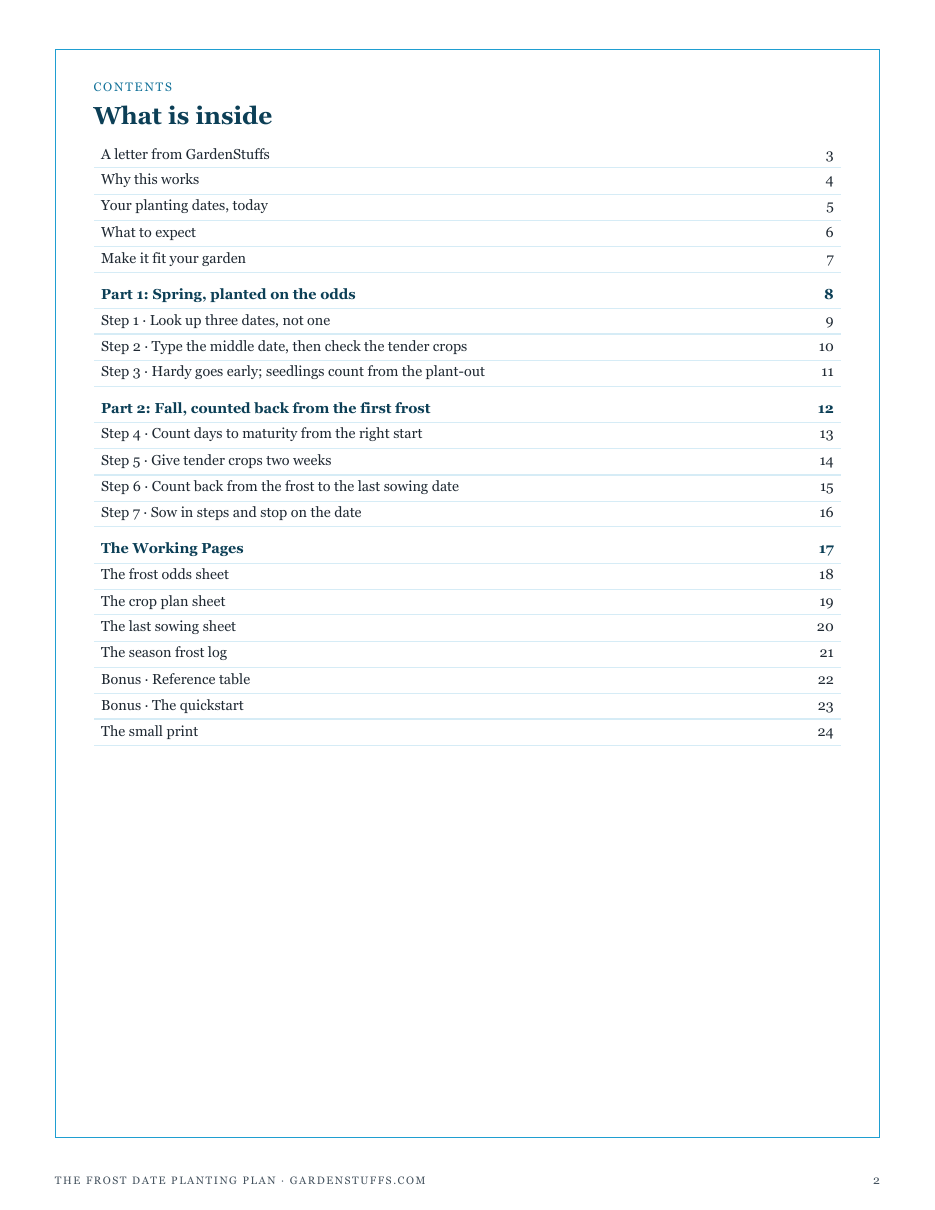
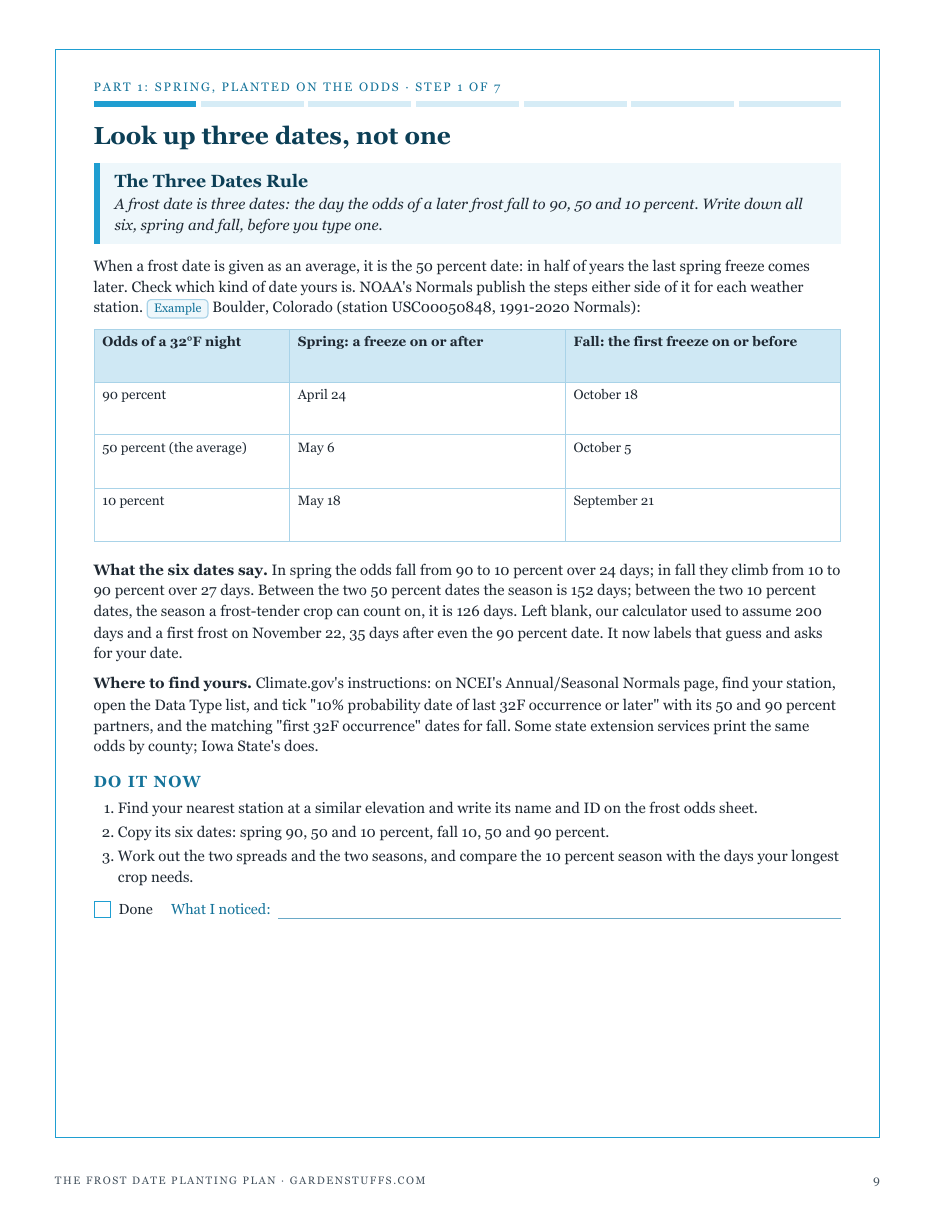
Two full pages from the plan, exactly as printed. Click either to read it at full size before you decide.
What is in it
- Step 1: three dates, not one: your station's 90, 50 and 10 percent spring and fall frost dates, and the seasons between them
- Step 2: the 50 percent date typed into the calculator, every tender plant-out held to the 10 percent date
- Step 3: hardy, semi-hardy and tender crops (Purdue's table), and seedling weeks counted back from each plant-out
- Step 4: days to maturity counted from transplanting or from sowing, and what sowing a transplant crop direct costs
- Step 5: the tender deadline two weeks before the average first frost, and each crop's days to spare
- Step 6: the count-back from the first frost to each crop's last sowing date
- Step 7: succession sowings two weeks apart that stop on the last sowing date, and a late-summer window for cool crops
- Four working pages: frost odds sheet, crop plan sheet, last sowing sheet and season frost log
- Reference table for the twelve crops our calculator knows, worked through for Boulder, Colorado
- Quickstart, plus a personalised sheet worked from your own frost dates and crop
- ✓ 24 printable pages
- ✓ 10 sections, worksheets and templates
- ✓ A second PDF worked out from the numbers you enter
- ✓ No account needed, just an email address
- ✓ Instant download; link valid 7 days
Price includes any taxes. Sold by GrabURL, who handle checkout and support. The charge appears on your statement as GrabURL.
The plan picks up where the free Planting Calendarleaves off. The calendar takes one last spring frost and one first fall frost and counts every crop from them, but a frost date is a probability: on the average date the chance of frost is still 50 percent. The plan carries it through: your weather station’s 90, 50 and 10 percent dates for spring and fall, each crop held to the date its frost class can take, seedling weeks counted back from the day it goes out, days to maturity counted from transplanting or from sowing, two weeks of margin for tender crops, and a last sowing date for every crop you sow in succession or for fall (the Plant Spacing Calculator says how many to sow). Every date in it is an example for you to replace. It covers timing only: insect and disease sprays follow their own labels.